
Before any trip that I lead, I do homework, even if it’s a destination I’ve been to before. I brush up on the birds and wildlife, and I try to figure out what plants and flowers we might see. And if the itinerary has a strong historical/cultural component, like the trip through the Caucasus Mountains from which I’ve just returned, I read up on the history.
So I can tell you this about the history of the Caucasus region: it’s a complete mess. That is to say, a bewildering, complicated, multi-layered jumble of events–wars, conquests, religious conflicts, changing governments, shifting boundaries, and migrating populations. For much of recorded history, the region was contested by three great empires: Russian, Ottoman, and Persian. Even before that time it knew little peace or stability; and since that time, the descendants of those empires have continued the struggle.
What this means to modern-day visitors to Azerbaijan, Georgia, and Armenia is that they will find themselves confronted by evidence of layers upon layers of history—an almost unbelievable number of them. On this recent trip, on the same morning, we visited a cave complex with evidence of winemaking from 6000 years ago (the oldest known); the impressive remains of a stone monastery built in the 12th century (with bezoar ibex on the cliffs above); and then rolled into modern, vibrant Yerevan (which is nevertheless described as the oldest capital city in Europe).
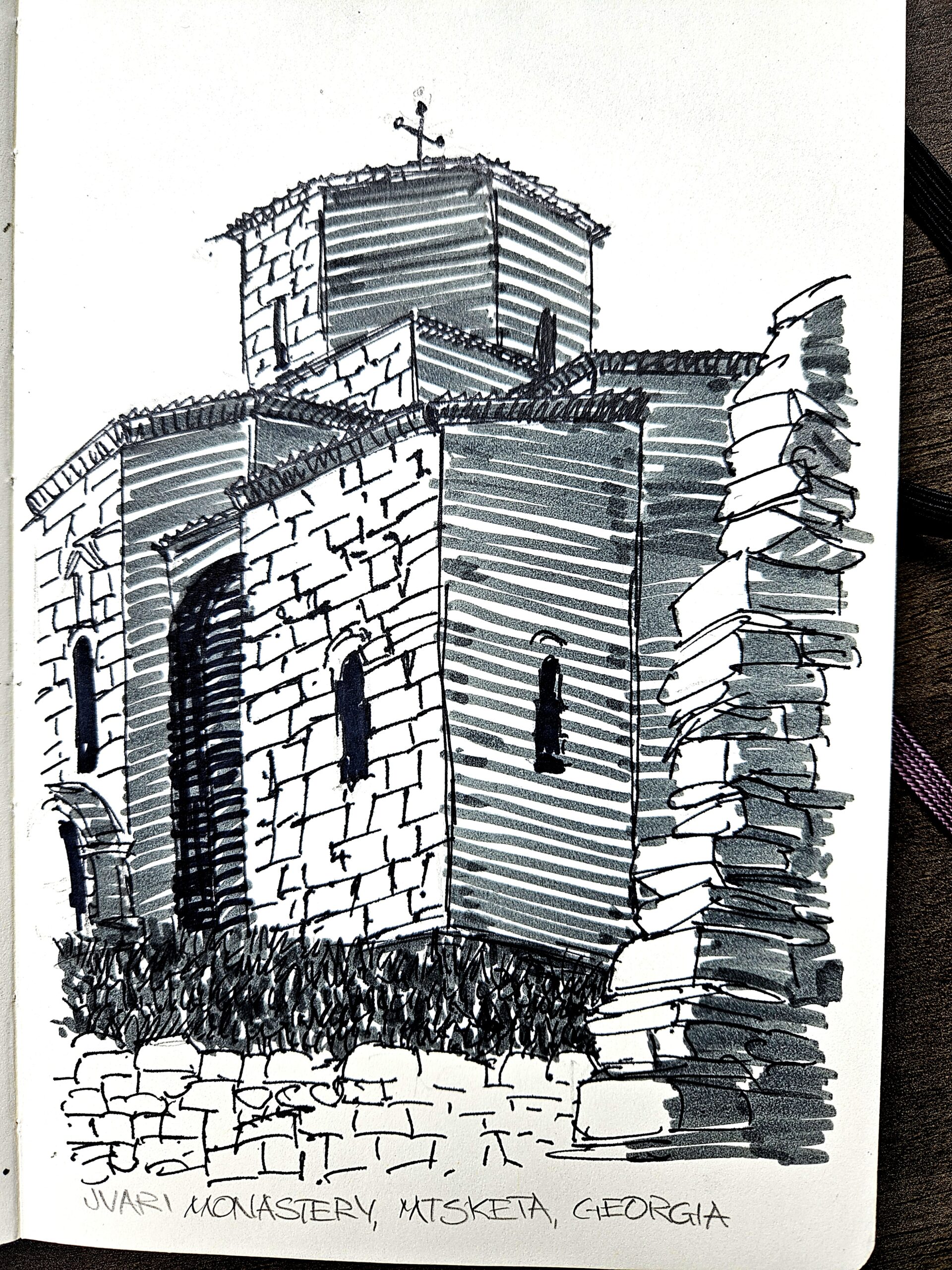
All these traces of lost peoples and civilizations are visually striking and impressive—great subjects for sketching. However, leading a busy and complex land trip like this one, I have little time to sit and draw. Basically, I grab a few minutes of downtime whenever the opportunity presents itself. I only bring a small “pocket-sized” sketchbook and black-and-white media.
Here are the results of the few brief, random times I was able to sneak away with my sketchbook. These small drawings are not at all a representative sampling of what we saw and experienced, let alone a complete record of the historical monuments of the area. But given how complex and messy that history is, maybe a random assortment is not such a bad way to embody it.


